One of the most important lessons I try to teach my patients is this:
Where you feel pain isn't always where the problem is coming from.
Your body is wired through an enormous network of nerves. Sometimes irritation in one area of the spine can produce symptoms somewhere surprisingly far away.
Maigne syndrome — also called thoracolumbar junction syndrome — is a great example.
Someone may come into my office pointing to their upper buttock, the top of their pelvis, their groin, or the outside of their hip.
Naturally, they assume:
"Something must be wrong with my hip."
Or:
"My SI joint keeps going out."
But when I examine them, sometimes the area that immediately catches my attention is considerably higher:
the junction between the thoracic and lumbar spine.
That's the area around the bottom of your rib cage where your mid-back transitions into your low back.
And that's where Maigne syndrome gets interesting.
What is Maigne syndrome?
Maigne syndrome describes pain associated with the thoracolumbar junction, generally around the lower thoracic and upper lumbar spine.
The classic region is around T12–L1, although adjacent segments can be involved as well. The syndrome was described by French physician Robert Maigne, who recognized that dysfunction around this part of the spine could produce pain much farther down the body. PubMed
Instead of necessarily hurting directly over T12–L1, symptoms can be referred toward areas such as the:
- posterior iliac crest or “top of the hip”
- upper buttock
- lateral hip
- groin or inguinal region
- lower abdomen
That referral pattern is one reason the condition can be confusing. PubMed
You can have a problem around the thoracolumbar junction without pointing to the thoracolumbar junction when I ask you where it hurts.
That is the big idea.
Why can it hurt somewhere completely different?
Think of the nerves leaving your spine like branches coming off a tree.
Around the thoracolumbar junction, different branches travel toward different parts of the pelvis, buttock and groin.
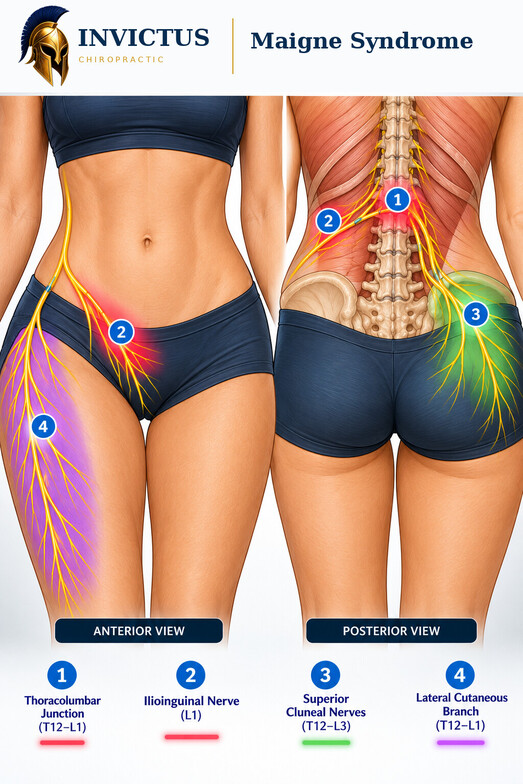
The posterior branches travel toward the back of the body and can contribute to symptoms around the iliac crest and upper gluteal region.
The anterior branches travel forward and can contribute to symptoms around the lower abdomen and groin.
The lateral cutaneous branches travel toward the side of the body and can contribute to pain around the lateral hip or trochanteric region. PubMed Central (PMC)
That's what I'm illustrating in the image above.
1. The thoracolumbar junction
This is the potential source region.
The thoracic spine is designed to work with the rib cage, while the lumbar spine has different mechanical demands. The transition between these regions creates an interesting mechanical area of the spine.
In Maigne syndrome, the symptomatic spinal segment is commonly described around T12–L1, although the broader thoracolumbar region can be involved. PubMed
2. The groin
This one surprises patients.
Pain around the inguinal or groin region doesn't automatically mean the problem started in the hip or groin.
The anterior nerve pathways associated with the upper lumbar region can refer symptoms into the lower abdomen and groin. PubMed Central (PMC)
That's why I don't want to examine only the exact square inch where someone points.
I want to understand what structures could reasonably refer there.
3. The iliac crest and upper buttock
This is probably the pattern I find most interesting.
The superior cluneal nerves travel from the posterior spinal nerve branches, course through the posterior tissues and cross the iliac crest to provide sensation over portions of the upper buttock.
Anatomical studies show that these small nerves interact closely with the thoracolumbar fascia and posterior iliac crest, and certain branches can pass through an osteofibrous tunnel where irritation or entrapment can occur. PubMed Central (PMC)
This can create a very convincing “SI joint” or upper-buttock complaint.
There is an important distinction here, though.
Superior cluneal nerve entrapment and Maigne syndrome can look similar, but they aren't automatically the same diagnosis.
A patient can have irritation referred from the thoracolumbar junction, peripheral irritation of a superior cluneal nerve near the iliac crest, or potentially overlapping findings. That's why the examination matters. PubMed
4. The outside of the hip
Another potential referral area is the lateral hip/trochanteric region.
And there's an important anatomical point here: this is not simply the lateral femoral cutaneous nerve.
Descriptions of thoracolumbar junction syndrome associate this lateral hip referral with the lateral cutaneous branches of the thoracolumbar nerves. PubMed Central (PMC)
So someone can point directly at the side of their hip, while part of my examination may happen much higher up their spine.
Why is Maigne syndrome easy to miss?
Because the painful area can distract us from the source.
If you point to your SI joint, everybody looks at the SI joint.
If you point to your hip, everybody looks at the hip.
If you point to your groin, everybody looks at the hip flexors and groin.
Those structures absolutely can cause pain — and they still need to be examined.
But there's another question worth asking:
What if the painful area is the victim rather than the culprit?
A recent systematic review discussing SI-joint pain specifically highlighted Maigne syndrome as one thoracolumbar source capable of mimicking pain near the PSIS, groin and lateral hip, reinforcing the importance of screening the thoracolumbar spine rather than assuming every posterior pelvic complaint originates locally. PubMed Central (PMC)
That's a principle I use throughout chiropractic assessment.
Don't chase pain.
Find out why it's there.
How would I examine this at Invictus Chiropractic?
I wouldn't diagnose Maigne syndrome because somebody looked at this picture and said, “Hey, that's exactly where I hurt.”
Pain maps give us clues. They don't give us diagnoses.
If the history makes me suspicious of a thoracolumbar source, I want to compare the painful area with what's happening mechanically elsewhere.
That can include examining movement through the thoracic and lumbar spine, palpating the thoracolumbar junction, evaluating the iliac crest and relevant nerve pathways, comparing side-to-side sensitivity, and determining whether movements or mechanical loading reproduce or change the patient's familiar symptoms.
Classically described examination findings include tenderness around the involved thoracolumbar segment, an iliac-crest point and altered sensitivity with a skin-roll/pinch-roll test. Diagnostic blocks have also been described in the medical literature when greater diagnostic certainty is required. PubMed
More importantly, I'm looking for a pattern.
One positive test doesn't tell the entire story.
Does every pain in these areas mean Maigne syndrome?
Definitely not.
Pain around the low back, pelvis, groin and hip has a large differential diagnosis.
Hip pathology, lumbar radiculopathy, sacroiliac disorders, muscular or tendon problems, hernias, visceral conditions, fractures and other neurological or musculoskeletal problems can sometimes produce overlapping symptoms.
That's exactly why I don't want patients using an infographic as a self-diagnosis.
The picture should make you think:
“Interesting. I didn't know the spine could refer pain there.”
Then we investigate whether that's actually happening in your case.
The takeaway
Maigne syndrome is a fantastic example of why treating only the location of pain can sometimes become frustrating.
Your groin pain might not start in your groin.
Your upper-buttock pain might not start in your buttock.
Your lateral hip pain might not start in your hip.
Sometimes the clue is sitting higher up at the transition between the thoracic and lumbar spine.
That's why when somebody comes into Invictus Chiropractic with a stubborn problem, I'm interested in more than simply:
“Where does it hurt?”
I also want to know:
“Why does it hurt there?”
That second question is usually much more interesting.
— Dr. Vlad Constantinescu, D.C.
Invictus Chiropractic | Calgary, Alberta
This article is for educational purposes and isn't intended to diagnose an individual condition. New, severe, progressive, traumatic, unexplained, or neurologically concerning symptoms warrant appropriate clinical assessment.